AL MENNIE
BIG WAVE SURFER - OCEAN EXPLORER - SURVEYOR - WRITER - SPEAKER
THE GIANT'S CROSSING
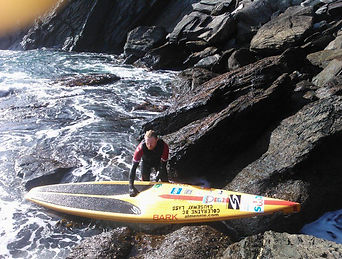
The First Paddleboard Crossing from the Giant's Causeway to the Scottish Island of Islay (2012)

THE GIANT'S CROSSING
The First Paddleboard Crossing from the Giant's Causeway to the Scottish Island of Islay (2012)
The Beginning
Long before I ever owned a paddleboard, there was an Admiralty chart hanging on the wall of our family home.
It showed the North Channel between Northern Ireland and Scotland. At the very top of the chart was a small piece of land — the Scottish island of Islay. On clear days I could sometimes see it on the horizon from the north coast, before it disappeared again into cloud and weather.
As a child I remember thinking:
"One day, I want to go there."
I had no idea how I would get there. I simply knew it fascinated me.
Years later, after discovering stand-up paddleboarding, that childhood curiosity became an expedition.
Designing the Crossing
In 2012 I began planning a paddleboard crossing from the Giant's Causeway to the island of Islay.
The North Channel is one of the most challenging stretches of water between Ireland and Scotland, dominated by powerful tides, unpredictable seas and constantly changing conditions.
Rather than waiting for perfect weather, I planned the expedition for early spring — a time when brief periods of calmer seas are possible, but the water remains close to its coldest.
The objective wasn't simply to paddle the distance.
It was to understand whether the crossing was actually possible using a standard ocean paddleboard and careful planning.
Preparation
Nobody could tell me exactly how the crossing should be attempted.
Every experienced skipper, fisherman and sailor I spoke to offered different advice. Some believed it couldn't be done at all. Others suggested modifying the board with additional ballast or different equipment.
The only way to answer those questions was to prepare for every possibility.
Training took place on rivers, along the coastline and in open Atlantic conditions. I practised in calm water, rough seas and winter storms. I trained to paddle both standing and lying prone in case conditions became too difficult to remain on my feet.
Nutrition, hydration and endurance planning were all carefully developed before the expedition began by Rich Robinson.
The Crossing
The expedition started from the Giant's Causeway.
Although accompanied by experienced support boats, the outcome remained unknown. No one knew how the complex tidal systems of the North Channel would affect a paddleboard throughout an entire crossing.
Early progress was encouraging.
At times I travelled at almost 5.7 miles per hour.
Later, as opposing tidal streams collided across the middle of the channel, my speed dropped to almost nothing. At one point I was moving forward at just 0.2 miles per hour. If I stopped paddling, I immediately began travelling backwards.
For 9 hours and 25 minutes I continued almost without interruption, stopping only briefly every ten minutes to drink.
As the crossing unfolded it became clear that the currents behaved differently than anyone had predicted.
The Sea of Jura pushed against the flow of the North Channel, forcing me westwards and dramatically altering the planned route.
The navigator's chart from the expedition still records both the intended course and the route the sea ultimately dictated.
Landfall
After more than nine hours on the water, I finally reached the island that had fascinated me since childhood.
Landing beneath the American Monument on Islay, I stepped ashore having completed a journey that had begun decades earlier with nothing more than a map on a living room wall.
What I learned from the Crossing
The expedition wasn't simply about endurance.
It reinforced something I had already begun to understand through years of ocean exploration:
The sea rarely behaves exactly as expected.
Charts, forecasts and experience all matter, but ultimately the ocean decides.
The Giant's Crossing became another lesson in preparation, adaptability and accepting uncertainty — principles that continue to influence every expedition I undertake.
Further Reading
The full story of The Giant's Crossing, including the planning, training, navigation and expedition itself, is explored in greater detail through my Tales Upon the High Seas audiobook and ebook series.
The expedition also raised funds for Northern Ireland Chest, Heart & Stroke, demonstrating how personal exploration can also support the wider community.